 用户: Caro蓝
时间: 2020-12-10 14:28:48 来自: iPad11,1
在“山东大学外国语学院《817鑫辉娱乐登录入口下载英语》历年鑫辉娱乐官方app下载真题汇编(含部分答案)”的内容第540页备注了学习笔记
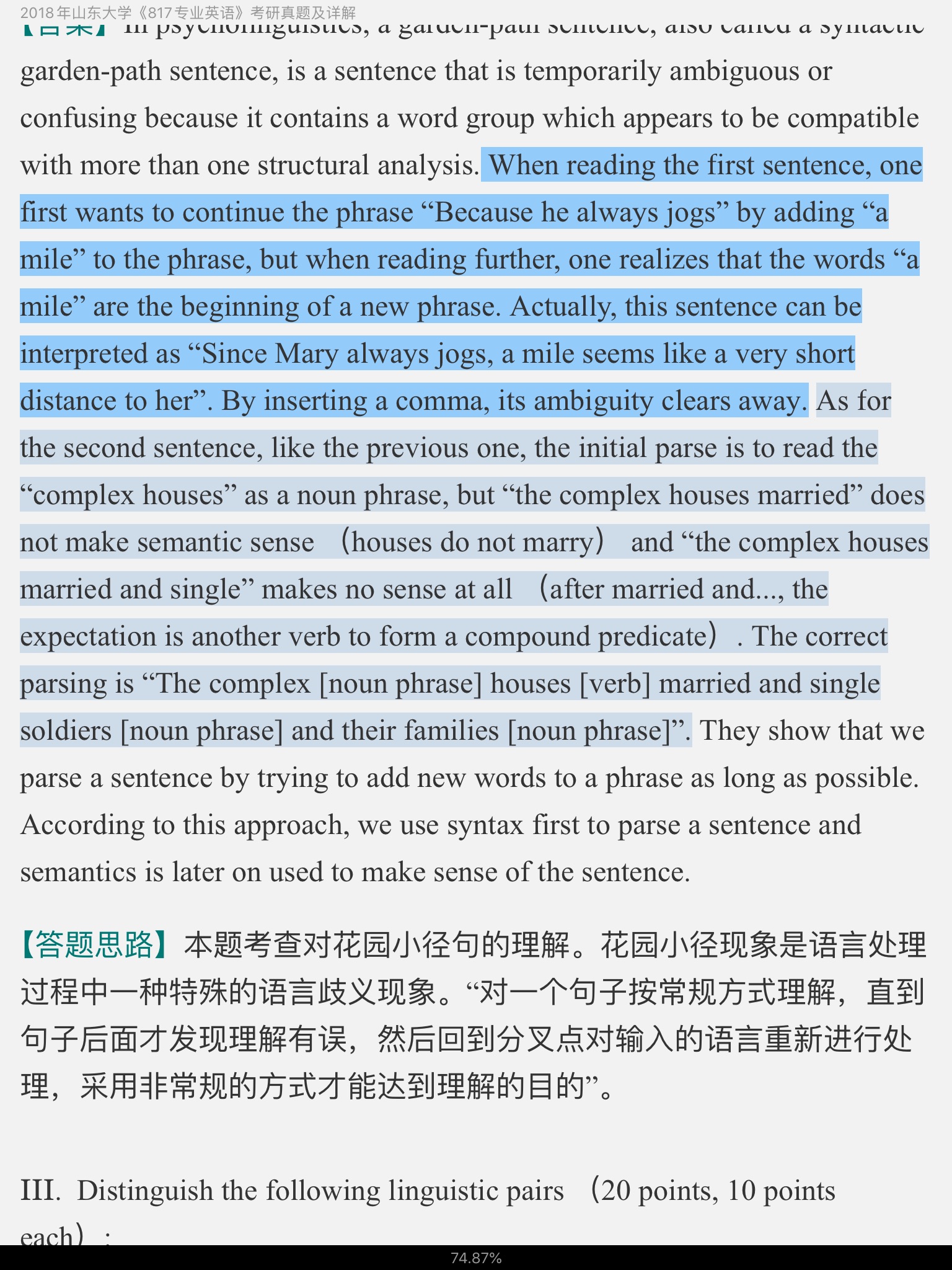
As for the second sentence, like the previous one, the initial parse is to read the “complex houses” as a noun phrase, but “the complex houses married” does not make semantic sense (houses do not marry) and “the complex houses married and single” makes no sense at all (after married and..., the expectation is another verb to form a compound predicate). The correct parsing is “The complex [noun phrase] houses [verb] married and single soldiers [noun phrase] and their families [noun phrase]”.
点击查看鑫辉娱乐官方app下载全文:前往在线阅读下载全文
用户Caro蓝正在学习的鑫辉娱乐官方app下载简介:
山东大学外国语学院《817鑫辉娱乐登录入口下载英语》历年鑫辉娱乐官方app下载真题汇编(含部分答案)
手机扫码阅读全文
2015年山东大学《817鑫辉娱乐登录入口下载英语》鑫辉娱乐官方app下载真题及详解
2016年山东大学《817鑫辉娱乐登录入口下载英语》鑫辉娱乐官方app下载真题及详解
2017年山东大学《817鑫辉娱乐登录入口下载英语》鑫辉娱乐官方app下载真题及详解
2018年山东大学《817鑫辉娱乐登录入口下载英语》鑫辉娱乐官方app下载真题及详解
2019年山东大学《817鑫辉娱乐登录入口下载英语》鑫辉娱乐官方app下载真题
